PE Paper, Paper Cup, Carrier, Holder (click photo !!)

Coffee bean Grinder (Click photo !)

Mobile Cases & Mobile Screen Protector (Click photo !)

WORLD CLOCK

Tuesday, November 6, 2012

Korean sauces steal spotlight at Seoul Gourmet

Top chefs drawn to pickled extract with 120 ingredients at Savor Korea event

Alex Atala, whose Brazil-based restaurant D.O.M. placed fourth on this year’s S. Pellegrino’s World’s 50 Best Restaurants, sampled Korean pickles and a 120-ingredient fermented extract at Seoul Gourmet’s Savor Korea event Tuesday. 

“All these fermentations and making pickles are something new for me,” said Atala. “This is special for me because the vegetables are very crunchy. The combination of flavors and textures are unbelievable.” 

Michelin-starred chef Thomas Buhner of Germany-based La Vie expressed interest in the 120-ingredient extract and revealed he wanted to try using it as a marinade. 
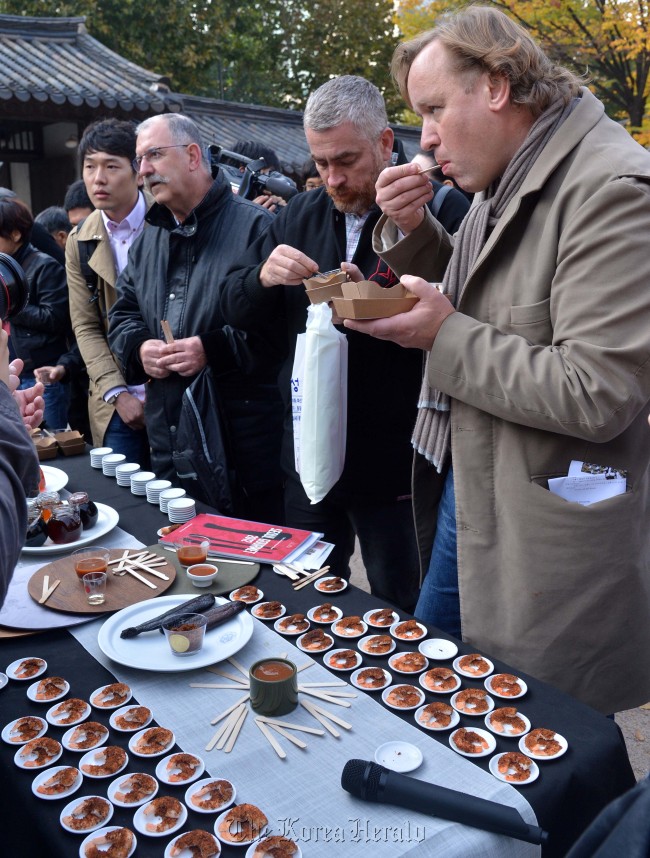
La Vie’s Thomas Buhner (right), D.O.M.’s Alex Atala (center), and Akelare’s Pedro Subijana sample Korean food at Unhyeon Palace in Seoul on Tuesday. (Lee Sang-sub/The Korea Herald)
“It’s a little sweet,” Buhner said of the extract, adding that it possessed fruit-like flavors reminiscent of apples and cherries.

The pickles and extract were all made by food researcher Choi Yeong-suk, who presented the Korean tradition of pickling to participating chefs of the international food festival Seoul Gourmet as part of the Savor Korea event held at Unhyeon Palace in Seoul on Tuesday. 

Choi explained how the extract was made with various roots like mountain yam and ginseng along with fruit from the Chinese matrimony vine and how the pickles were made from raw, not cooked, ingredients, preserving the crunchy textures of the vegetables and roots. 

After tasting the extract, pickled lotus root and chestnuts, Atala told The Korea Herald, “This is something I will try to understand and maybe incorporate into my cuisine.”

Choi was one of six experts presenting key Korean culinary traditions at Tuesday’s event with the aim of giving world-renowned chefs a closer look at hansik and its roots. 

Cuisine researcher Lee Jong-kuk introduced chefs to Korean pastes and sauces, including vinegar made from makgeolli (Korean rice wine). 

“The base of our food is very important,” said Lee as he explained why he focused on soy sauce, fermented soy bean paste and vinegar. 

Korean Traditional Wine Institute head Park Rock-dam and Research Institute of Korean Royal Cuisine director Chung Kil-ja presented fermented wines and palatial food respectively, while Haap owner-chef Sin Yong-il showcased his Korean desserts. 

Chefs were also able to sample omija (Schisandra chinensis) berries from the Hyojongwon Estate. 

“Omija is very delicious,” Buhner said, adding that he liked the sweet and sour flavors of the fruit. 

The Unhyeon Palace event was part the Savor Korea program, which started with a visit to Yangjae-dong’s Hanaro Mart and finished with a trip to Noryangjin Fisheries Wholesale Market. 

The aim of Savor Korea is to give participating chefs an in-depth course on Korean food. Savor Korea is part of a five-day festival where seven prominent culinary masters learn about hansik and incorporate Korean ingredients into their dishes. 

“We will be taking away a lot of good flavors,” said Michelin-starred chef Gennaro Esposito of Italy-based Torre del Saracino. 

The annual festival, now in its fourth year, will run through Nov. 3, with an extended run from Nov. 5 through Nov. 30 for Seoul Gourmet Avenue. 

Participating chefs will be serving special dinners using Korean ingredients at Lotte Hotel Seoul, Westin Chosun, Sheraton Grande Walkerhill, the W Seoul-Walkerhill, Shilla Seoul and the Plaza Hotel through Nov. 2, and will prepare a Grand Gala feast at the Grand Hyatt Seoul on Nov. 3. 

Chefs will also be holding master classes from Nov. 1-3 at Sejong University. Five modern Korean restaurants ― including Jungsikdang ― will also be participating in the festival, while 20 to 30 restaurants in Seorae Village will be taking part in a three-week event called Seoul Gourmet Avenue. 

For more information or to make reservations, visit www.seoulgourmet.org. 

By Jean Oh (oh_jean@heraldcorp.com)

Sunday, November 4, 2012

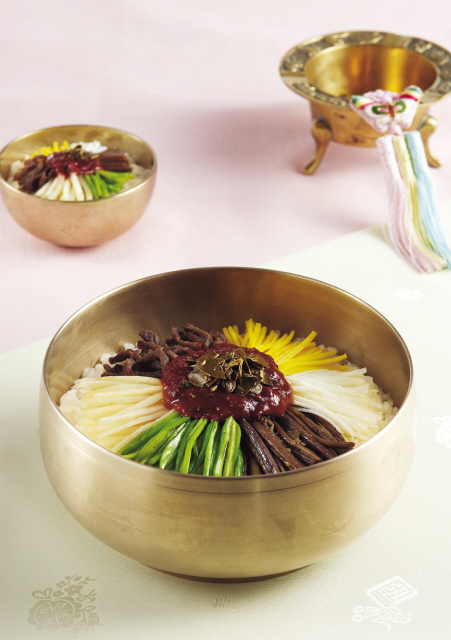
Bibimbap (Rice mixed with vegetables and beef)


Updated : 2012-11-02 19:44
Bibimbap (Institute of Traditional Korean Food)
Bibimbap is a mixed dish of cooked white rice, vegetables, beef, garnishes and stir-fried red pepper paste. It is said that this dish came from the customs of memorial rites and rural villages. This dish is very easy to prepare, just mixing together cooked white rice with various vegetables, namul and red pepper paste.

Ingredients

● 2 1/2 cups non-glutinous rice, 3 cups water

● 300 g young pumpkin, 1/2 tsp salt

● 200 g skinned bellflower roots, 1 tsp salt

● 120 g beef (top round), 200 g soaked bracken

● seasoning sauce : 1 tbsp soy sauce, 1/2 tbsp sugar, 2 tsp minced green onion, 1 tsp minced garlic, 1 tsp sesame salt, 1/8 tsp ground black pepper, 1 tsp sesame oil

● 2 eggs

● 3 g kelp, 2 tbsp edible oil

● stir-fried red pepper paste: 5 tbsp red pepper paste, 20 g minced beef, 2 tsp minced green onion, 1 tsp minced garlic, 6 tbsp water, 1 1/2 tbsp sugar, 1 1/2 tbsp sesame oil

1. Wash the rice, soak in water for 30 minutes, drain.

2. Cut the young pumpkin into matchsticks, season with salt. Slice bellflower roots, add salt and rub them with hands, let sit for 10 min. then rinse and squeeze water out.

3. Clean blood off the top round, cut into strips. Wash the bracken and slice. Season beef and bracken with seasoning sauce.

4. Panfry egg for garnish, slice.

5. Put the rice and water in the pot, heat for 4 min. on high heat. When it boils, continue to boil it for another 4 min. then lower the heat to medium. When the rice become sodden, lower the heat to low and cook for 10 minutes.

6. Preheat the frying pan and oil, stir-fry pumpkin on high heat for 30 sec. spread out and cool.

7. Preheat frying pan and oil, stir-fry bellflower roots on medium heat for 5 min.

8. Preheat frying pan and oil, stir-fry beef and bracken respectively on medium heat for 3 min.

9. Pour oil into the pan, oil fry kelp on medium heat for 10 sec. Keep pieces large.

10. Put the minced beef, green onion, garlic and half of the sesame oil in the pot, stir-fry them on medium heat for 2 min. Add red pepper paste, sugar and sesame oil, stir-fry for 5 min. Add water into it, stir-fry for another 3 min. to make fried red pepper paste (167 g).

11. Serve steamed rice with prepared ingredients and red pepper paste on top.

Tips
● If the rice boils over, open the lid quickly and close again.

● The rice should be neither too hard nor too watery.

● When preparing stir-fried red pepper paste with home-made red pepper paste, add a little more sugar.

● Stir-fried red pepper paste may be adjusted to taste.

Sunday, October 28, 2012

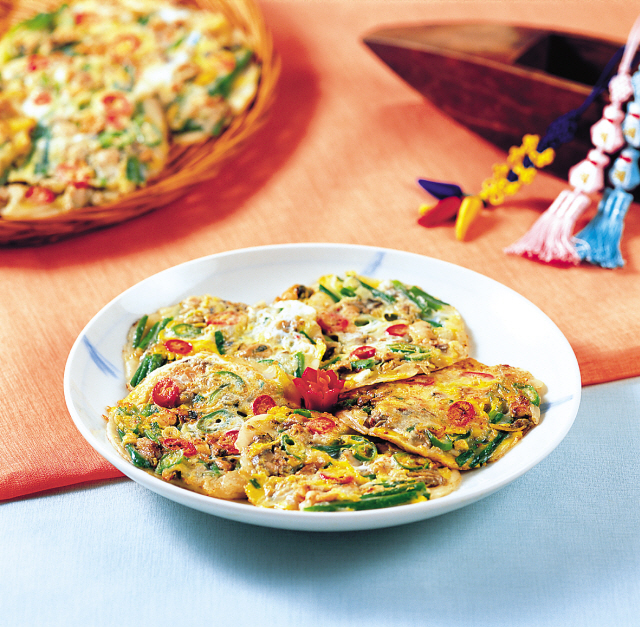
Haemul pajeon (Seafood green onion pancake)

Haemul pajeon (Institute of Traditional Korean Food)
Haemul pajeon is a savory pancake with plenty of green onion and seafood coated with mushy dough and beaten egg on top. Haemul pajeon is a well-harmonized dish that is studded with soft green onions and tasty seafood. Dongnae-pajeon is a famous variety from the city of Busan.

Ingredients
● 100g mussel meat, 70g clam meat, 70g oysters : 5 cups water, 1/2 tsp salt

● seasonings : 1 tsp salt, 1/8 tsp ground black pepper

● 200g small green onion, 1 ea green pepper, 1 red pepper

● dough : 1 cup wheat flour, 1/3 cup non-glutinous rice powder, 1/4 salt, 1 cup water

● 1 egg

● 1/2 cup edible oil

● vinegar soy sauce : 1 tbsp soy sauce, 1 tbsp vinegar, 1 tbsp water

1. Wash seafood in salt water, and drain on a strainer (190g). Shred into 1 cm-wide pieces, season with salt and ground black pepper, then let sit for 10 min.

2. Cut the green/red pepper 2 cm-long and 0.3 cm-thick diagonally and seed. Trim and wash small green onion, cut into 10 cm-long (150 g).

3. Add non-glutinous rice powder, salt and water to the wheat flour, then mix thoroughly (270g).

4. Beat egg.

5. Blend vinegar soy sauce.

6. Preheat the frying pan and oil. On medium heat, put half ladle of dough on the pan.

7. Place small green onion on the dough and add prepared seafoods, green/red pepper. Spread out another half ladle of dough, and spread 2~3 tbsp of beaten egg over it.

8. On medium heat, panfry for 5 min. When bottom is well done, turn over, cover the lid, fry for another 3 min.

9. Serve with vinegar soy sauce.

Tips
● For “Dongrae” green onion pancake, non-glutinous rice powder or glutinous rice powder with anchovies soup may be added into the dough.

●Beaten egg may be an option upon taste.

Monday, October 22, 2012

Spicy kimchi kept me warm in winter’


An American Peace Corps volunteer, front, is encouraged to drink at a traditional Korean house in this undated photo.
/ Courtesy of The Korea Foundation

Peace Corps volunteers recount their discovery of Korea in late 1960s

By Kang Hyun-kyung

The first group of American Peace Corps volunteers to come to Korea in the mid-1960s had their own way of keeping warm during the icy winter weather, despite the poor heating systems.

Some wore several layers of clothes, while others recalled how Korean hospitality and warmth helped them survive the severe winter weather.

Garry Katsel, who was in the Peace Corps service in Suwon, and the Yongsan military base in Seoul from 1966 to 1969, said Friday that hot spicy Korean kimchi helped a lot during the wintertime.

“I considered kimchi to be my central heating system,” he said. “I got up in the morning in the middle of winter. I always had a bowl of rice with some kimchi, usually a bit of soup. I would be freezing once I got off my yi-bul (bedclothes). But once I got kimchi, I started sweating.”

Katsel, who taught English at middle and high schools in Suwon for two years, said at that time teachers had a rule to follow regarding when to use coal stoves in classroom.


“When I first came there, I remember the law was that when the temperature of the classroom reached zero degrees centigrade, we had to put coal in the stove to make a fire,” he said.

Like Koreans, Katsel said he used to wear several layers of clothes to stay warm in winter.

He is one of four former Peace Corps volunteers who joined a roundtable meeting with The Korea Times for an interview at the Somerset Hotel in Seoul on Friday.

Katsel arrived in Seoul last week for the first time since he left the country in 1969 for a week-long trip sponsored by the Korea Foundation. Eighty-six former Peace Corps volunteers joined the trip.

President of Friends of Korea Jon Keeton, who worked with the Korea Foundation to organize the trip, said Korea is the only country that has provided such a trip for Peace Corps volunteers.


Chris Nottingham, who taught English at a middle school in the northeastern city of Sokcho, Gangwon Province, in 1970 and ‘71, said he has a vivid memory of the cold winter weather.

“In my school, we didn’t have a gymnasium. We used to have the school assembly outdoors,” he said. “You can imagine what it was like in the middle of winter in Sokcho, a fishing town, with cold wind coming up. All the students were out there and teachers would stand in line in front of them.”

When he wore his overcoat, Nottingham was told that Korean teachers don’t do that and had to take it off.

“So I had to stand in front of the teachers and students just like all the other teachers who were without overcoats,” he said.

Poor but warm people

The Peace Corps volunteers said two major changes they observed from four decades ago are in school uniforms and the disappearance of Chinese characters from newspapers.

Bruce Knee, a former science teacher at a high school in Sangju, North Gyeongsang Province from 1966 to 1969, said school uniforms are much more colorful, fashionable and attractive now.

In those days, he recalled, students wore the same black uniform and had the same haircut.

“Students were well behaved and respectful, and teachers were very supportive,” Knee said.

He shared his experience of a warm Korean family during his three-year stay in Korea.

On a snowy Sunday morning in February 1969, Knee said he joined his Korean friend on a trip to his home in a distant village for the Lunar New Year holiday.

Knee and Silkyeong couldn’t get a bus to a stop near his village. This didn't deter us, Knee said.

“I put my toothbrush and a cake of soap into my jacket pocket and off we went through the slush and mud, over a railroad bridge (because the footbridge had been washed away), through streams, and onto a boat that ferried us across a river,” he said.

“We reached our destination over four hours later. What a greeting! What hospitality! Silkyeong had a traditional, honest, hardworking, well-mannered family barely touched by outside influences.”

Knee said his Korean friend came from a farming family – materially poor but rich in their love of life.

“Next morning since Silkyeong was on vacation and it was still part of the Lunar New Year's country holiday I made most of the trek back alone along the same route to attend my school duties. The bus still wasn't running.”

Technology savvy

The former volunteers agreed that one thing that has not changed between those days and now is Koreans’ zeal for education and a national focus on technology.

Don Boileau, who taught upper-level public administrators at the Central Officials’ Training Institute in Seoul, said the country’s respect for technology was noticeable even in the late 1960s.

He said he was enamored by the nation’s keen attention to the spaceflight of Apollo 11 when it landed Neil Armstrong and Buzz Aldrin, on the moon in July 1969.

The Korean government designated the day a national holiday.

Boileau, now a professor at the Department of Communication at George Mason University based in Fairfax, Virginia, said schools closed and every Korean gathered to watch television.

His host family didn’t have a television set at home, although the breadwinner was a doctor in the upper-middle class. He and the family went to the house next door where the third daughter of the family, who worked for a German pharmacy company, had a TV.

“The whole family gathered there to watch the men land on the moon. That was the day that I left Korea,” he said.

“The country felt this was such advanced technology. That sort of thinking was there in 1969.”

Boileau’s remarks were construed as meaning that the Korean government’s prioritization of technology as a policy focus was a key driving force that led to the country’s current global status in technology.

Time of change

More than 1,000 young men and women from America came to this country as Peace Corps volunteers from 1966 to 1981. They were here at a time of change.

Nottingham witnessed two historical events while he was here in the early 1970s as a Peace Corps volunteer and several years later as a U.S. State Department official working at the U.S. Embassy in Seoul.

“I vividly remember when I was in the Peace Corps in 1970 and ‘71, Kim Dae-jung, then the John F. Kennedy of Korean politics, was coming to land in helicopter in Sokcho,” he said.

“I was here when the former President Park Chung-hee was assassinated in October 1979. It was a sad and turbulent time.”

After returning to the United States upon completing his Peace Corps work in Sokcho, Nottingham came back to Korea in 1977 as a State Department official. The U.S. Embassy in Seoul was his first foreign posting. He left Seoul two months after Park was assassinated.

Through the Peace Corps, Nottingham said, he had the opportunity to experience Korea as a young adult and from the point of view of a young professional and became a keen observer of the nation. 

Sunday, October 14, 2012

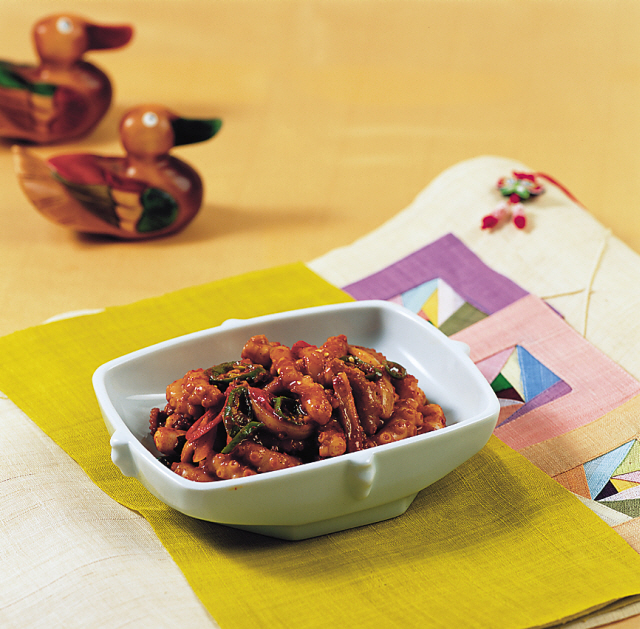
Nakji bokkeum, (Stir-fried baby octopus)

Nakji bokkeum (Institute of Traditional Korean Food)
“Nakji bokkeum” is stir-fried baby octopus with various vegetables and seasonings. There is a saying: “If you feed three or four octopi to a scraggy cow, it will soon have strength.” Octopus has been enjoyed as a health food since the olden days. It tastes best in the autumn and winter. Octopus can also be grilled, or served raw and sliced.

Ingredients
● 2 1/4 baby octopus

● 1 tbsp salt

● 2 tbsp wheat flour

● 1/2 onion head

● 1 1/2 ea green pepper

● 1 ea red pepper

● 1 tbsp edible oil

● 1 tsp sesame oil

● Seasoning sauce: 1 tsp soy sauce, 1 tbsp red pepper paste, 2 tbsp ground red pepper, 1 tsp sugar, 1 tbsp minced green onion, 1/2 tbsp minced garlic, 1/2 tsp minced ginger, 1/8 tsp ground white pepper, 2 tsp sesame oil

1. Turn the octopi heads inside out, remove internal organs and eyes, and clean with salt water and wheat flour.

2. Cut the head into 6 cm-long, 1.5 cm-wide pieces and the legs into 6 cm-long pieces (350g).

3. Trim and clean the onion and shred at intervals of 1 cm (80g).

4. Wash the green and red peppers, cut into 2 cm long and 0.3 cm thick diagonally and remove seeds (green pepper 14g, red pepper 16g).

5. Blend the seasoning sauce.

6. Preheat the frying pan and oil. Stir-fry the onion for 1 min. on high heat. Add octopi and seasoning and fry for 1 min. more.

7. Add green and red peppers and sesame oil, pan-fry for 20 sec. on high heat.

Tips
● Carrot and/or other vegetables may be added upon taste.

● Quick frying on high heat will serve better color and result in less watery octopus.

(Adapted from the Institute of Traditional Korean Food)

Saturday, October 6, 2012

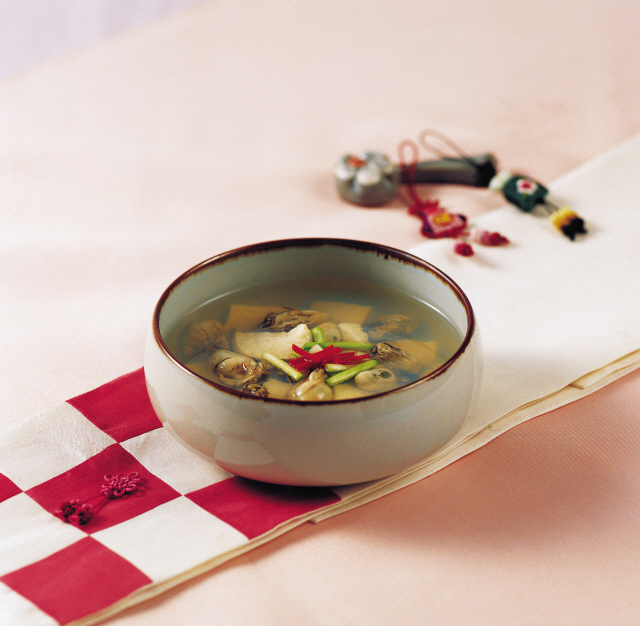
Guldubu jjigae (tofu stew with oysters)

Guldubu jjigae (Institute of Traditional Korean Food)
Guldubu jjigae is a clear stew made of oysters, tofu and salted anchovy juice. Among seafood, the oyster contains the highest amount of nutrients and plenty of protein, so Koreans refer to them as “milk from the sea.” Oysters have been widely enjoyed in Korea since the country is surrounded by sea on three sides.
Ingredients
● 100g oysters, 1 cup water, 1 tsp salt

● 1/3 tofu cake

● 20g small green onion, 1/2 red pepper, 1 tsp minced garlic

● 3 1/2 cups water, 1 tbsp salted shrimp juice, 1/2 tsp salt, 1/4 tsp sesame oil

1. Rinse the oysters in salt water and drain.

2. Cut the tofu into squares.

3. Trim and wash the green onion and cut it into long slices. Halve the red pepper and seed, then shred it at intervals.

4. Boil water for 4 minutes on high heat. Season with salted shrimp juice, add oysters, tofu and minced garlic, boil for another 3 minutes.

5. When the oysters and tofu float, add small green onion and red pepper, season with salt, bring to the boil, then add sesame oil.

Tips
● To ensure a clean and clear soup, do not boil too long after adding the oysters.

● Adjust the amount of salt according to the saltiness of the shrimp juice.

● Oysters may be replaced with salted pollack roe.

(Adapted from the Institute of Traditional Korean Food)

Sunday, September 30, 2012

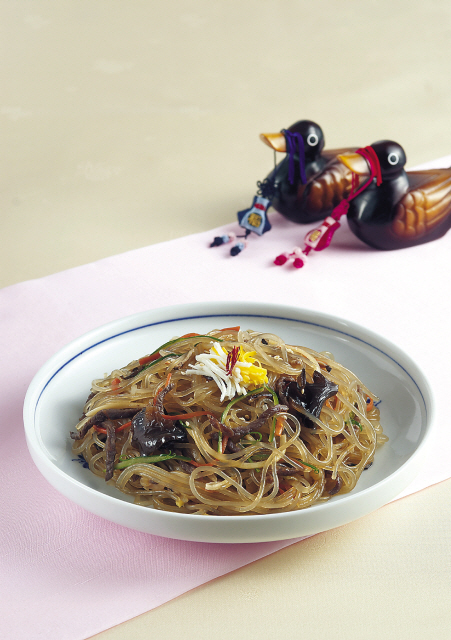
Japchae (potato starch noodles stir-fried with vegetables)


Japchae (Institute of Traditional Korean Food)
Japchae is a dish of potato starch noodles mixed with various stir-fried vegetables. Japchae is served without fail on holidays and traditional ceremonial days. The name japchae, or sundried vegetables, came about because it is mixed with various vegetables.

Ingredients
● 50g beef (top round), 10g (2 sheets) brown oak mushrooms, 3g Jew’s ear mushrooms

● Seasoning sauce ①: 1.2 tbsp soy sauce, 1/2 tsp sugar, 1/2 tsp minced green onion, 1/4 tsp minced garlic, 1/2 tsp sesame salt, 1/2 tsp sesame oil, 0.1 g ground black pepper

● 1/3 ea cucumber, 1/2 tsp salt, 30 g carrot, 1/8 tsp salt

● 30 g skinned bellflower roots, 1/2 tsp salt, 1 onion

● 30 g mung bean sprouts, 2 cups water, 1/4 tsp salt

● Mung bean sprout seasoning : 0.5 g (1/8 tsp) salt, 2 g (½ tsp) sesame oil

● 60 g (1 ea) egg, 0.5 g (1/8 tsp) salt

● 60 g potato starch noodles, 400 g (2 cups) boiling water

● seasoning sauce ②: 1 tbsp soy sauce, 1 tbsp sugar, 1/2 tbsp sesame oil, 1/2 tbsp sesame seeds, 1/4 tsp salt

● 2 tbsp edible oil

Clean blood off the beef, shred the meat into 6 cm-long, 0.3 cm-wide and thick (45g) portions, then season them with half of the seasoning sauce ①.

Soak the mushrooms in water for about 1 hour, remove stems of brown oak mushrooms and shred it into pieces 0.3 cm wide and thick (28g). Separate Jew’s ear mushrooms by sheet (18g), season them with the remaining half of the seasoning sauce ①.

Wash the cucumber, cut 5~6 cm long and 0.3 cm-thick around, shred 0.3 cm wide (23g). Wash the carrots and skin. Cut and slice them 5~6 cm long and 0.3 cm wide and thick (20g), marinate with salt for 5 min. and dry.

Cut the bellflower roots into the same size as the cucumber (26g), wash it with salt by fumbling for 1 min. to draw out bitter taste. Skin and wash the onion, and shred it to the same size as the cucumber (100g). Remove the heads and tails of mung bean sprouts (26g).

Panfry egg as yellow/white garnish, cut it into 4 cm long and 0.3 cm wide/thick.

Preheat the frying pan and oil. Stir-fry the beef, brown oak mushrooms and Jew’s ear mushrooms for about 2 min. on medium heat.

Preheat the frying pan and oil. Stir-fry the cucumber and carrot respectively for 30 sec. on high heat. Stir-fry the bellflower roots and onion for 2 min. on medium heat.

Pour water in the pot, heat it up for 2 min. on high heat. When it boils, scald mung bean sprouts with salt for 2 min., drain water through a strainer (24g), mix it with mung bean sprout seasoning.

Pour water in the pot and heat it up for 2 min. on high heat. When it boils, add potato starch noodles and boil it for 8 min. Take out the noodles and drain water, cut strands into 20 cm long and mix with seasoning sauce ②.

Preheat the frying pan and oil. Stir-fry the noodles for 2 min. on medium heat.

Mix everything together and top with yellow/white garnish.

Tips
● To get the better quality and better color, all ingredients for this dish should be fried quickly on high heat.

● Pork, spinach and oyster mushrooms may be used as substitute ingredients for this dish.

(Adapted from the Institute of Traditional Korean Food)